
Astronomy
What is a light-year?
A familiar unit of time gives astronomers a way to talk about immense distances.
Start with sunlight
Light needs about eight minutes to reach Earth from the Sun. That gives us two ways to describe the gap: about 150 million kilometers, or about eight light-minutes. Both describe the same distance.
A light-year uses the same idea on a larger scale. It measures the distance light travels through a vacuum in one year, about 9.46 trillion kilometers. The year tells you how long to let the light travel.
Use the unit on a nearby star
Proxima Centauri is roughly 4.25 light-years away. The light arriving from it tonight left the star about four years and three months ago. At the distance of our closest stellar neighbor, the delay is already longer than a typical high school education.
Multiplying the distance in light-years by 9.46 trillion gives an approximate distance in kilometers. The kilometer figure works, but light-years make it easier to compare several stars at a glance.
A telescope also shows the past
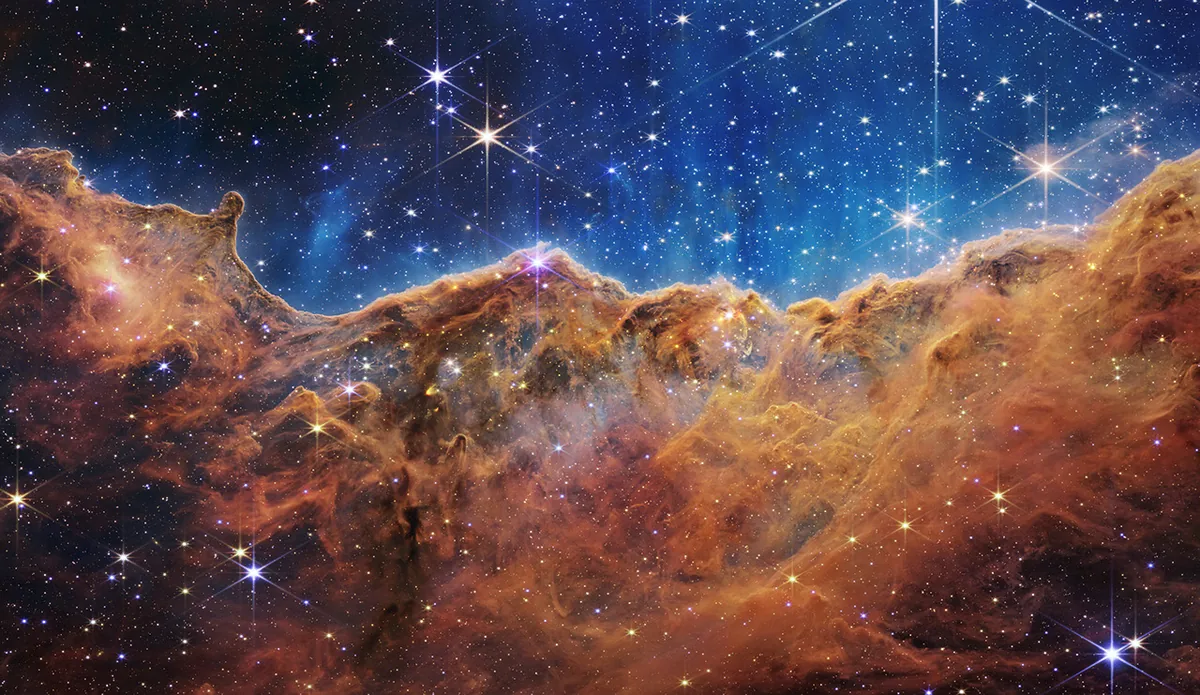
Astronomers see distant objects as they were when the light began its journey. The bright ridge in the Webb image above sits in a star-forming region of the Carina Nebula, roughly 7,600 light-years from us. Webb recorded light that had been traveling for thousands of years.
The photograph combines observations made through several infrared filters. The image team assigned visible colors to those wavelengths so details from the different filters could be viewed together.